Merton Award

  • Robert K. Merton Award 2026

    Robert K. Merton Award 2026

    Ozan Aksoy and Aron Szekely, Making Sense of Honor Killings, published in American Sociological Review, 2025

    Studies that rigorously test micro-level mechanisms to explain the emergence and persistence of macro-social phenomena are inherently valuable and deserving of publication in leading scholarly outlets. Yet some contributions are especially significant because they address societal problems with profound moral and public implications. The work of Ozan Aksoy and Aron Szekely belongs firmly in this category, tackling a phenomenon that deeply affects communities and carries severe and enduring consequences for individuals and societies alike.

    Their article presents an impressive and methodologically rigorous study that combines theoretical innovation with a sharply defined empirical focus. The paper is distinguished by its precise specification of explanatory mechanisms, its careful and thoughtfully constructed research design, and its successful integration of micro-, meso-, and macro-level processes within a coherent analytical framework. The methodological procedures are both innovative and transparent, enabling readers to clearly evaluate how the evidence substantiates the theoretical arguments. Equally remarkable is the clarity of the writing, which renders a complex and sensitive subject accessible without sacrificing analytical sophistication or nuance.

    Importantly, the theoretical and empirical contributions of this work open promising new avenues for the study of collectively sanctioned violence, a field of inquiry that is both timely and urgently needed.

    It was a genuine pleasure to read this article and an even greater pleasure to recognize its outstanding contribution by awarding its authors the prestigious 2026 Robert K. Merton Award.

    The award committee

    • Elisa Bellotti
    • Federico Bianchi
    • Marco Giesselmann
  • Robert K. Merton Award 2025

    Robert K. Merton Award 2025

    Marco Giesselmann, David Brady and Tabea Naujoks, The Increase in Refugees to Germany and Exclusionary Beliefs and Behaviors, published in American Journal of Sociology, 2024

    In 2015–16, Germany experienced a rapid and controversial increase in refugees that varied substantially across German districts. This increase provides unique leverage for analyzing how fractionalization, threat, and contact shape the consequences of immigration and ethnolinguistic heterogeneity. Using the German Socio-Economic Panel and local district-level administrative data on refugee shares, the paper innovatively focuses on within-person/within-district change in six exclusionary beliefs and behaviors. The paper demonstrates a two-level cross-cutting process that integrates threat and contact theory but contradicts fractionalization theory. As the refugee share increased nationally, concerns about immigration and Far Right party support increased. However, district-level refugee shares significantly reduced concerns about immigration and Far Right party support. Also, rising district-level refugee shares are not associated with concerns about social cohesion, trust, residential moves, and subjective fair tax rates. While districts with fewer refugees drove the national-level threat, rising district-level refugee shares reduced or did not heighten exclusionary beliefs and behaviors.​

    Marco Giesselmann, David Brady, and Tabea Naujoks receive the 2025 Robert K. Merton Award for their excellent paper on “The Increase in Refugees to Germany and Exclusionary Beliefs and Behaviors”.

    The 2025 award committee

    • Elizabeth Roberto (chair)
    • René Flores
    • Janet Xu
    • Yuan Hsiao
  • Robert K. Merton Award 2024

    Robert K. Merton Award 2024

    René D. Flores, María Vignau Loría, and Regina Martínez Casas, Transitory versus durable boundary crossing: what explains the indigenous population boom in Mexico?, published in American Journal of Sociology, 2023

    René D. Flores, María Vignau Loría, and Regina Martínez Casas receive the 2024 Robert K. Merton Award. We congratulate them for their excellent paper on “Transitory versus durable boundary crossing: what explains the indigenous population boom in Mexico?”.

    Here is what the Award Committee (Neha Gondal, Christopher Muller, Daniel Schrage, and Clemens Kroneberg) said:

    Flores et al. take on an intriguing and compelling yet simple sociological puzzle: what accounts for a sudden rise in the self-identified indigenous population in Mexico. The authors draw on multiple methods, rigorous data collection, innovating research design, and close attention to underlying mechanisms to investigate this puzzle.

    Challenging the popular explanation that the rise of indigenous persons in Mexico is attributable to natural demographic processes, the authors draw on a demographic projection model and a series of clever survey-based experiments to show that natural processes account for only twelve percent of this change. The remaining change, they find is linked to phrasing switches in the 2010 census identification question. The authors run three survey experiments using different versions of the self-reported ethnicity question among nationally representative samples of Mexicans. They isolate two types of changes in self-identification: what they call transitory crossing, a short-lived and reversible change which was induced via word changes that presented ethnicity in ways that made it more appealing to a broader segment of the population. They also find durable crossing, which they argue is a longer-lasting, gradual process motivated by macro-political forces such as social movements and government policies. This second form of boundary crossing is activated by Mexico’s embrace of multiculturalism.

    Overall, the Flores et al. paper, makes for compelling analytical sociology. Congratulations to the winners for this well-deserved recognition of their work!

    The award committee

    • Neha Gondal (chair)
    • Christopher Muller
    • Daniel Schrage
    • Clemens Kroneberg
  • Robert K. Merton Award 2023

    Robert K. Merton Award 2023

    Christopher Muller and Daniel Schrage, The political economy of incarceration in the cotton south, 1910–1925, published in American Journal of Sociology, 2021

    Christopher Muller and Daniel Schrage receive the 2023 Robert K. Merton Award. We congratulate them for their excellent paper on “The political economy of incarceration in the cotton south, 1910–1925”.

    Here is what the Award Committee (Elizabeth Bruch, Martin Arvidsson, Amir Goldberg, and Ozan Aksoy) said:

    This article brings novel empirical analysis and evidence to bear on a classic question in the political economy of punishment. Social theorists have long argued that increases in incarceration are linked to contractions in labor demand. But prior work is largely descriptive, lacking analytical clarity about the mechanisms that give rise to this association as well as causal evidence. The authors elegantly resolve these issues by combining rich historical data on mechanisms with a natural experiment on a boil weevil infestation in Georgia. In doing so, they advance a conditional theory of the political economy of punishment that can be extended to other times and places.

    The topic is important. The article is written free of obscure jargon. The study combines methodological rigor with a clear and convincing causal design and a meticulous data collection. The theoretical mechanisms that link labor demand with incarceration are carefully described and rigorously assessed. Importantly, the authors also establish scope conditions establishing the conditions under which the observed relationship between incarceration and labor demand would not hold. Overall, this is an exemplary demonstration of how the tools of causal inference and the richness of historical data can be integrated with the theoretical aims of analytical sociology.

    The award committee 2023

    • Elizabeth Bruch (chair)
    • Martin Arvidsson (2022 Robert K. Merton Award winner)
    • Amir Goldberg
    • Ozan Aksoy
  • Robert K. Merton Award 2021

    Robert K. Merton Award 2021

    Hanno Kruse and Clemens Kroneberg, More than a Sorting Machine: Ethnic Boundary Making in a Stratified School System, published in American Journal of Sociology, 2019

    The Robert Merton Award of 2021 goes to Hanno Kruse and Clemens Kroneberg for their paper titled “More than a Sorting Machine. Ethnic Boundary Making in a Stratified School System”, published in the American Journal of Sociology 125(2), 2019. This is what the Award Comittee (Klarita Gërxhani, Arnout van de Rijt, Filiz Garip, Javier Polavieja) said:

    “The article examines the structural conditions that shape ethnic boundary making in the school setting. More specifically, it investigates the contextual dependence of peer relations and identities by connecting school networks to local ethnic stratification.

    Its empirical findings show that the relationship between educational attainment and identification with mainstream society is not context-invariant; it depends on the place particular students occupy relative to their co-ethnic peers in the wider system of stratification. The findings also show that Muslim minority students do not increase their identification as Germans even in local contexts that are particularly conducive to boundary crossing. Such a crucial finding suggests that macro-level barriers and processes can trump the effect of local-context dynamics.

    The article provides an excellent balance between theoretical ambition, sophisticated empirical analysis, and substantive disciplinary relevance. It is not only a very good example of analytical sociology, but also one that can speak to a broader audience.”

    The award committee

    • Klarita Gërxhani,
    • Arnout van de Rijt,
    • Filiz Garip,
    • Javier Polavieja
  • Robert K. Merton Award 2020

    Robert K. Merton Award 2020

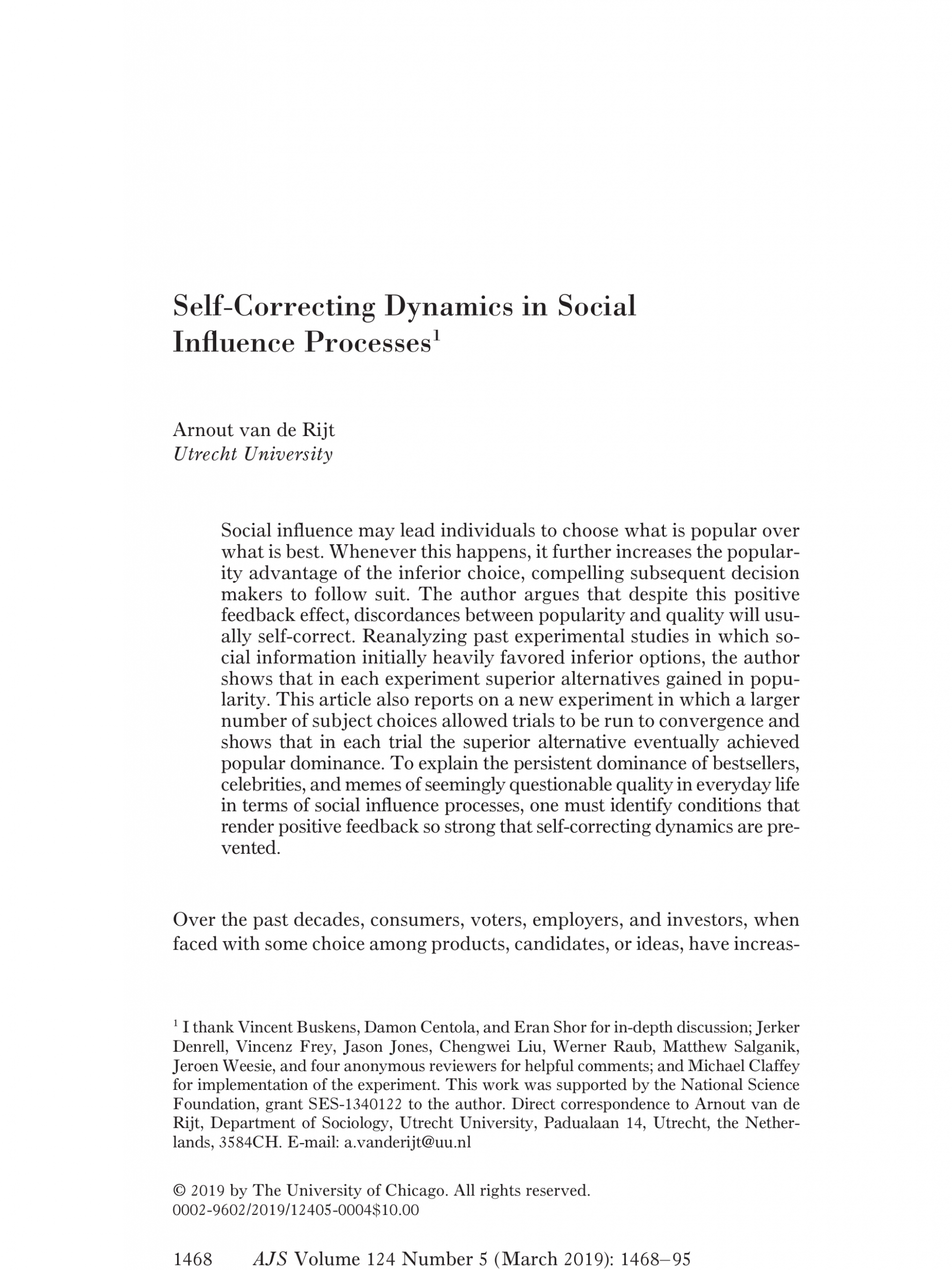
    Arnout van de Rijt, Self-Correcting Dynamics in Social Influence Processes, published in American Journal of Sociology, 2019

    Arnout van de Rijt receives the 2020 Robert K. Merton Award. We congratulate him for his excellent paper on self-correcting dynamics in social influence processes, published in the American Journal of Sociology 124(5), 2019. Here is what the Award Committee says:

    “The article questions a widely accepted theory in contemporary sociology according to which a self-reinforcing process, rendering the popular even more popular, allows inferior objects (low-quality products, unqualified people, or bad ideas) to become and maintain successful. Information technology, for example in social media, is a context where this mechanism is believed to be particularly relevant because it continuously exposes users to up-to-date information on the popularity of objects.  Social influence, so the established hypothesis goes, may lead individuals to choose what is popular over what is best and create dysfunctional Matthew effects.

    Combining re-analyzes of prominent experiments and an own online experiment, the author demonstrates that such self-reinforcing processes require a very strong degree of positive feedback. He also reveals that in many prominent empirical studies levels of feedback are lower, so that popularity dynamics are instead self-correcting, with superior choices becoming dominant over time.

    With clearly explicated explanatory mechanisms that causally relate micro- and macro-level influences and effects, the author builds on and challenges highly prominent earlier work about self-reinforcing social influence. The main strength of the paper is in taking a new and highly informative perspective on these data. Its important contribution to analytical sociology lies in adding a crucial new aspect to an existing theory and extending existing methods such that they can highlight how this crucial aspect makes a big difference for the macro-outcomes that arise from micro-level social influence.”

    Our honorable mention goes to Lars Leszczensky and Sebastian Pink for their network study on the drivers of ethnic homophily, published in the American Sociological Review 84(3), 2019. We are proud for having received a great set of submissions.

    • Marc Keuschnigg (chair)
    • Daniel Alexandrov
    • Andreas Flache
    • Amir Goldberg
  • Robert K. Merton Award 2018

    Robert K. Merton Award 2018

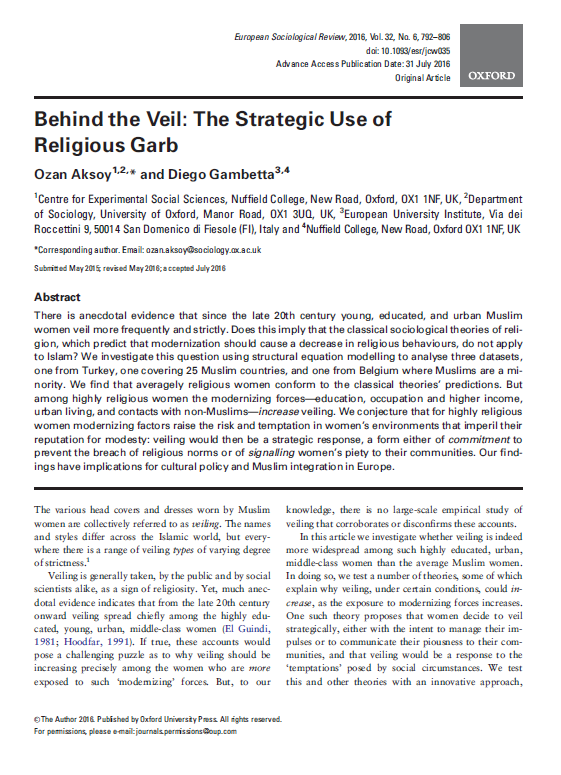
    Ozan Aksoy and Diego Gambetta, Behind the Veil. The Strategic Use of Religious Garb, published in European Sociological Review, 2016

    There is anecdotal evidence that since the late 20th century young, educated, and urban Muslim women veil more frequently and strictly. Does this imply that the classical sociological theories of religion, which predict that modernization should cause a decrease in religious behaviours, do not apply to Islam? We investigate this question using structural equation modelling to analyse three datasets, one from Turkey, one covering 25 Muslim countries, and one from Belgium where Muslims are a minority. We find that averagely religious women conform to the classical theories’ predictions. But among highly religious women the modernizing forces—education, occupation and higher income, urban living, and contacts with non-Muslims—increase veiling. We conjecture that for highly religious women modernizing factors raise the risk and temptation in women’s environments that imperil their reputation for modesty: veiling would then be a strategic response, a form either of commitment to prevent the breach of religious norms or of signalling women’s piety to their communities. Our findings have implications for cultural policy and Muslim integration in Europe.

    The award committee

    • Gianluca Manzo (Chair)
    • Gunn Elisabeth Birkelund
    • Marc Keuschnigg
    • Christian Steglich
  • Robert K. Merton Award 2017

    Robert K. Merton Award 2017

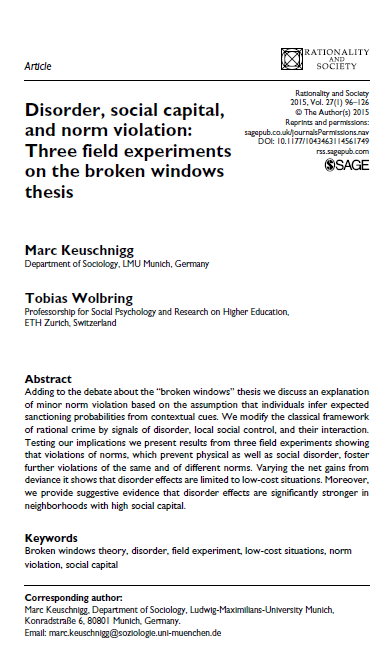
    Marc Keuschnigg and Tobias Wolbring, Disorder, social capital, and norm violation: Three field experiments on the broken windows thesis, published in Rationality and Society, 2015

    The Robert K. Merton Award in Analytical Sociology 2017 is awarded to the article “Disorder, social capital, and norm violation: Three field experiments on the broken windows thesis”, Rationality and Society 27: 96-126. The authors are Marc Keuschnigg from The Institute for Analytical Sociology, Linköping University and Tobias Wolbring from the School of Business and Economics, Friedrich-Alexander-University Erlangen-Nürnberg.

    Award statement:

    “By studying minor norm violations, the authors address an ubiquitous and fascinating social problem. Their paper takes on a theory – the broken windows theory – that is already well-known and well-studied, but nevertheless manages to further improve the theory.

    They do so by making two contributions.  First, they provide new scope conditions, by showing that its key mechanisms of spreading disorder only apply under specific conditions in which the costs of deviance are sufficiently low. Second they extend the theory, by highlighting how local social capital interacts with the informativeness of signals of disorder.

    Building on rational choice theory, the paper outlines clear mechanisms that provide new and informative hypotheses on these issues.

    Empirically, the paper nicely demonstrates the usefulness of field experiments in sociology. Through a series of clever experimental designs, the authors are able to convincingly test their hypotheses and establish the causal mechanisms that underly the spread of social disorder.

    In the end, the study not only contributes to a general theory of norms, but also nicely demonstrates how an analytical approach that accounts for individual incentives, actions, and social interaction, can fruitfully explain social phenomena.”

    The award committee

    • Delia Baldassarri
    • Rense Corten
    • and Sarah K. Cowan
  • Robert K. Merton Award 2016

    Robert K. Merton Award 2016

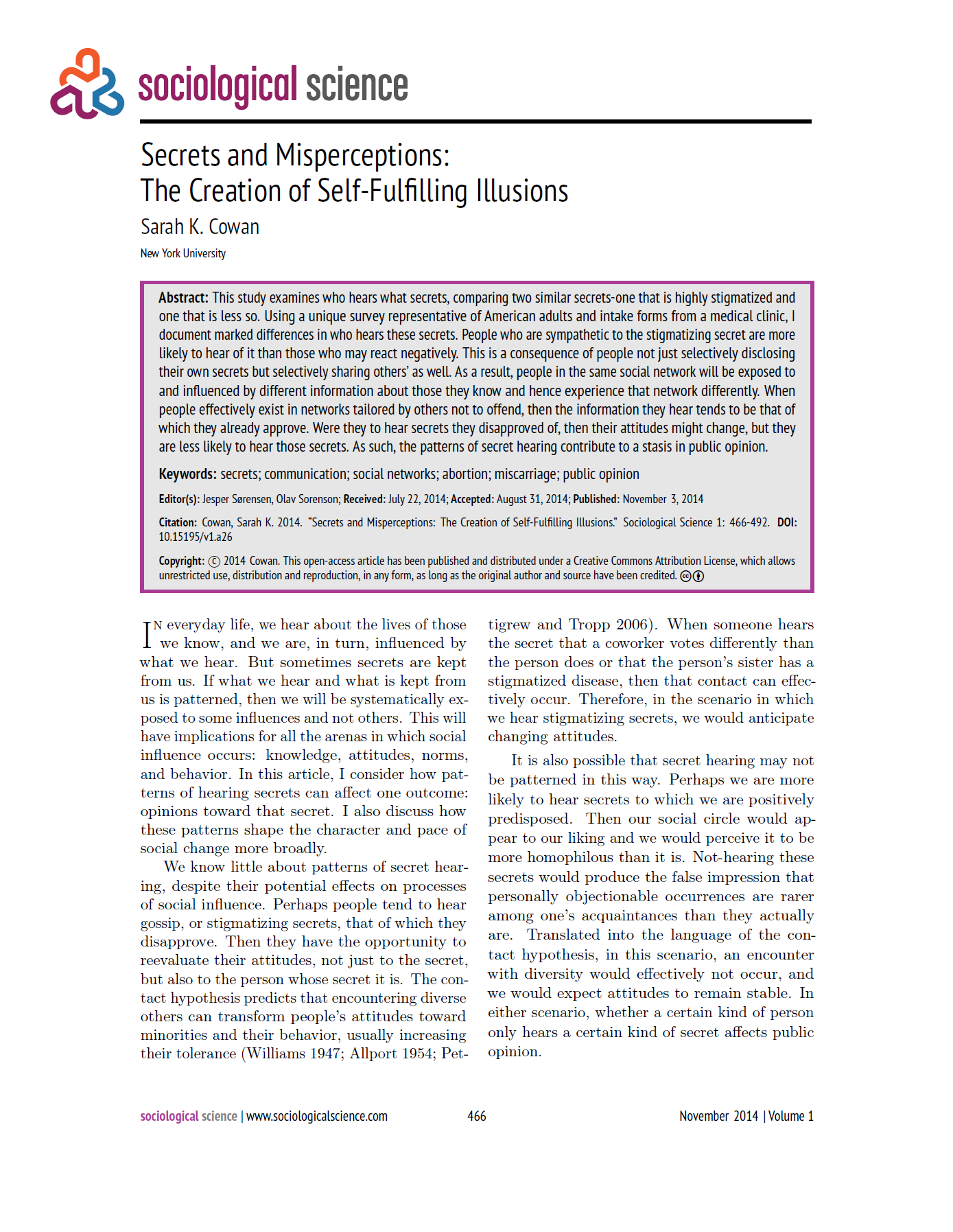
    Sarah K. Cowan, Secrets and Misperceptions: The Creation of Self-Fulfilling Illusion, published in Sociological Science, 2014

     The Robert K. Merton Award in Analytical Sociology 2016 is awarded to Sarah K. Cowan from New York University for her paper “Secrets and Misperceptions: The Creation of Self-fulfilling Illusions”, published in Sociological Science.

    This study examines who hears what secrets, comparing two similar secrets — one which is highly stigmatized and one which is less so. Using a unique survey representative of American adults and intake forms from a medical clinic, I document marked differences in who hears these secrets. People who are sympathetic to the stigmatizing secret are more likely to hear of it than those who may react negatively. This is a consequence not just of people selectively disclosing their own secrets but selectively sharing others’ as well. As a result, people in the same social network will be exposed to and influenced by different information about those they know and hence experience that network differently. When people effectively exist in networks tailored by others to not offend then the information they hear tends to be that of which they already approve. Were they to hear secrets they disapprove of then their attitudes might change but they are less likely to hear those secrets. As such, the patterns of secret-hearing contribute to a stasis in public opinion.